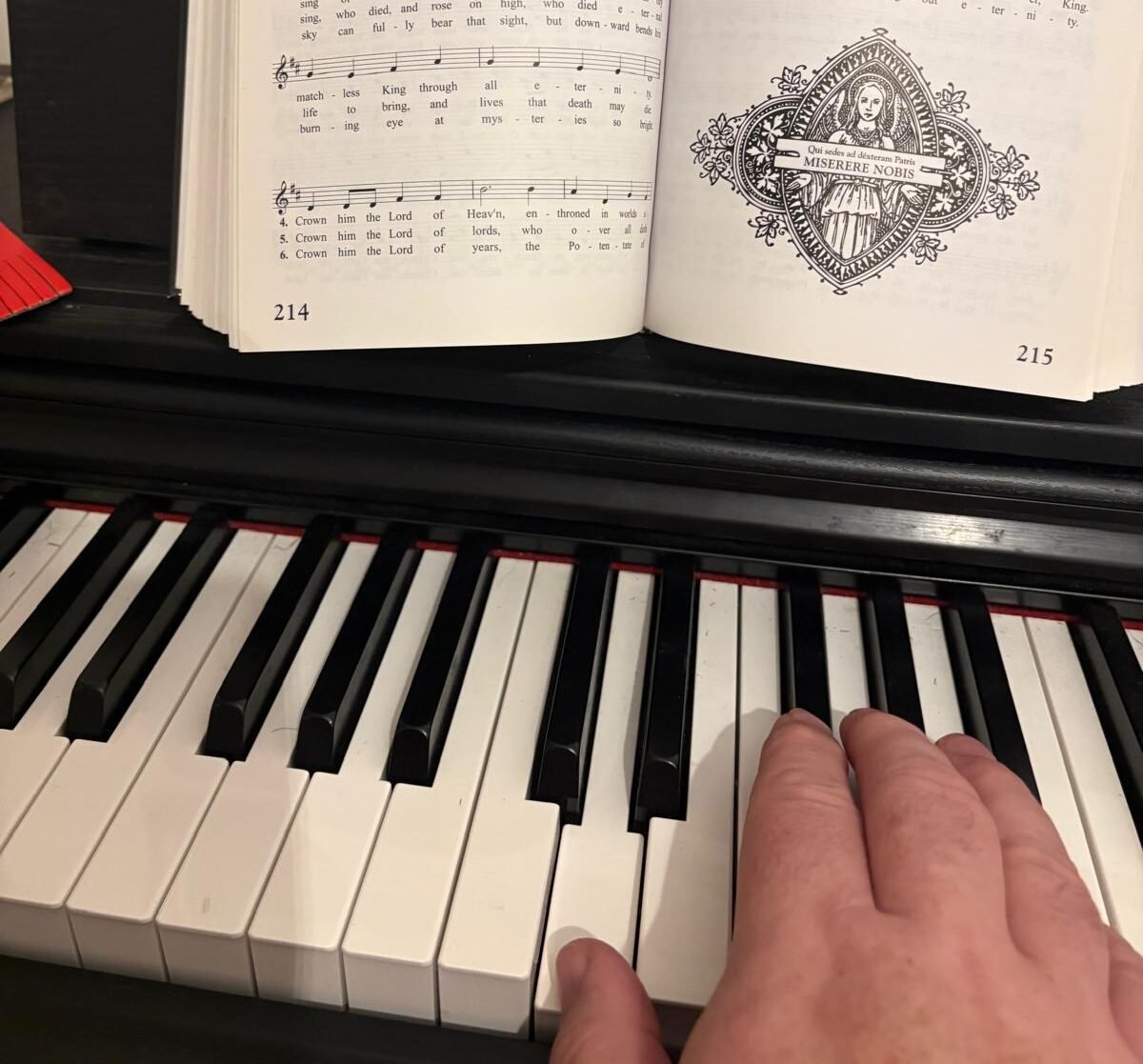
““They were some bangers today!”
Perhaps an unusual thing to hear at the end of Holy Hour, but that was the feedback after a
selection of Marian anthems during our May devotion. Mary, who could be called the very first
Tabernacle, was the first to carry the true Body of Christ.
Hymns are a wonderful part of our liturgies, and the generosity of our musicians enriches our
worship week after week. Yet, beyond their liturgical place, most of us have favourites: hymns
that fill us with joy, whose words speak to us deeply, or which awaken powerful memories.
“Immaculate Mary” reminds me of processions in Lourdes.
“The Lord of the Dance” reminds me of my grandmother and her love of the Corries.
“Colours of Day” will surely remind many people of primary school assemblies.
Then there are hymns that carry even deeper associations. “I Watch the Sunrise” can almost
make me smell incense again, bringing back memories of serving funerals as a young altar
server, thurible in hand.
Since ordination, serving here in Edinburgh, I have also heard a rather more questionable
“hymn” played at the end of funerals. There is at least a passing mention of the Lord:
“While the Chief puts sunshine on Leith
I’ll thank Him for His work…”
I am not sure I would recommend it for liturgical use though!
There is, however, a deeper point in all of this. Hymns are enjoyable to sing, and we treasure
the memories they carry, but in the liturgy they are far more than background music or
nostalgia. They are prayer.
Through hymns, the congregation becomes more than an audience; we become participants in
worship together. A hymn can lift the heart, teach the faith, unite generations, and help us enter
more fully into the mystery celebrated at the altar. Their beauty lies not simply in hearing them,
but in allowing them to draw us into the presence of God.
We all have our gifts in life, and singing is certainly not one of mine, as many unfortunate
congregations can confirm. But hymns are not just for the tuneful. They belong to all of us. We
sing, and in singing, we pray.
Reflecting on favourite hymns, something encouraged recently by the oral history group, is
about far more than compiling a “Top of the Pops.” It is a chance to think about which hymns
have touched us, and why.
So what would your favourites be? One for nostalgia? One from a favourite season of the
Church’s year? Or perhaps one that always draws you into prayer? I would love to hear them —
and the memories that come with them.
Revd Eddie White