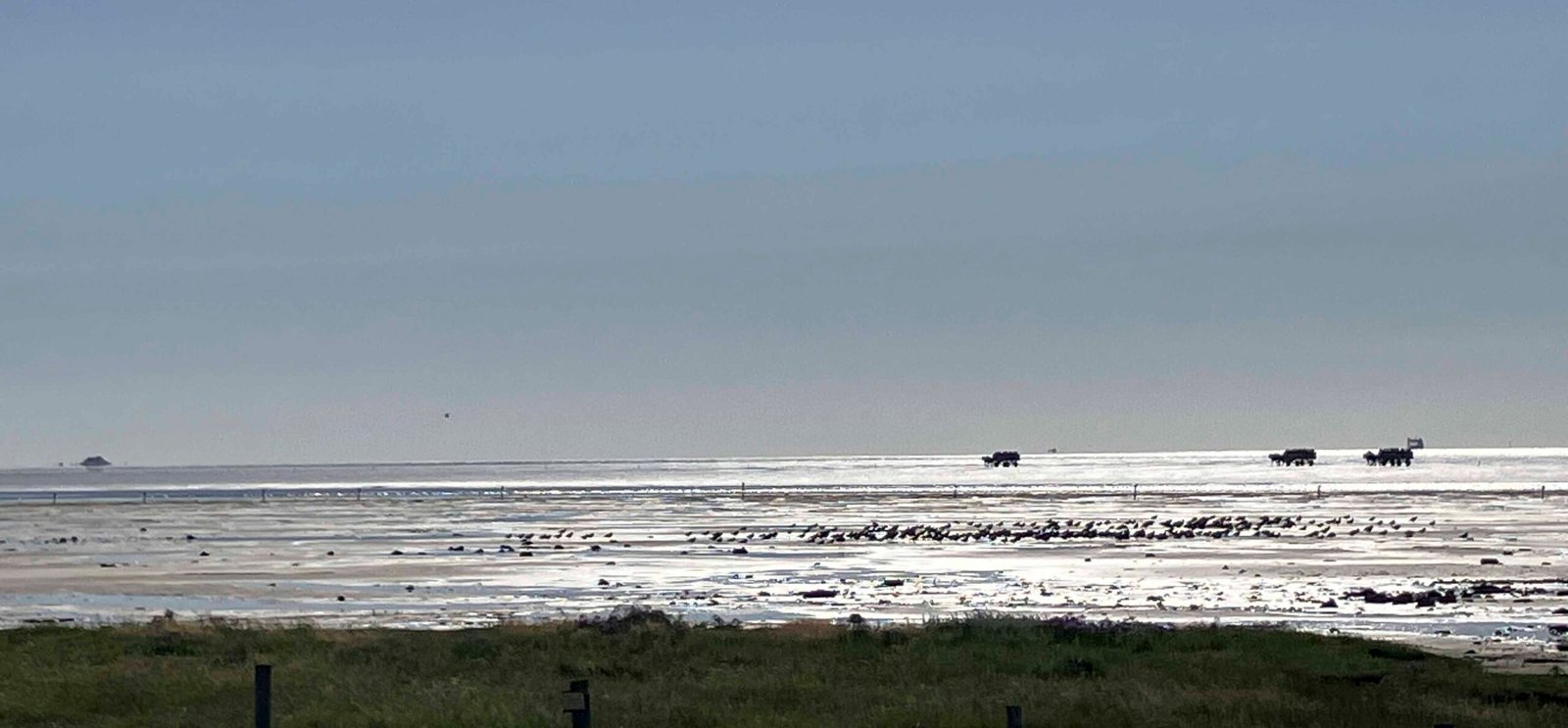
The very first piece I wrote for this blog concerned saunt*, which refers to a cultural imprint that persists long after something or someone has physically disappeared. While on holiday this summer in Germany, we discovered a prime example of what saunt is all about.
There’s a 40-metre-long medieval church buried beneath the mud where the bustling port of Rungholt once stood†. Like many settlements on the west coast of Schleswig-Holstein – as well as across Denmark, The Netherlands and UK – Rungholt disappeared beneath a massive flood in January 1362, just one among several storm surges around this time that significantly reshaped the north European coastline. It took the inhabitants by surprise, breaking through the defensive dikes and causing major loss of life, with no chance to gather family or livestock, to load up boats two by two.
Naturally, legends have sprung up around these lost towns and villages, expressed in literature, poetry and song: that Rungholt suffered divine retribution for its inhabitants’ transgressions, that it hoards buried treasure, or that on certain tides one can hear the church bells ring. Raised in Suffolk, I’m familiar with this latter claim in connection with Dunwich, much of which was lost to the very same storm flood, the remainder trudging slowly but inevitably towards the sea as coastal erosion slices giant slabs off East Anglia like cake to a potential son-in-law. In the case of Rungholt, bell ringing would be difficult as only the church’s foundations survive. But, since we’re given to romanticising (local hero Theodor Storm would not approve), let’s imagine the cross at the top of the steeple sticking out of the Wattenmeer (Wadden Sea) at low tide, a blackened rod angled against the vast horizon like a sundial; that the church lies miraculously intact beneath, buried wholesale, incorruptible to the incursion of mud; perhaps, after some vigorous digging, one might lift a slate or two and peer down into the nave, illuminating the bodies of sheltering peasants, perfectly preserved in fervent prayer, embraced by each other as by anoxia; … quickly, quietly, return the slates and let them be, lest time slips its way in, resentful of their enduring stand.
What remains of the medieval coastline today is the peninsula of Nordstrand, a few islands, and the Halligen, which are small mounds typically topped with a farmhouse or two (I bet Amazon doesn’t deliver) that push their luck annually against the winter flood tides. In summer, you can ride out on horse and cart from Nordstrand across the salt marshes to Südfall, a Hallig that lies very close to where Rungholt once stood (it’s that distant bump to the left of the photo). Nordstrand itself has a pottery – Nordstrander Töpferei, a favourite haunt of ours – whose designs are inspired by medieval artefacts recovered from the Wattenmeer. Clearly, traces of Rungholt are deeply embedded in this landscape, on many levels, an almost mythical presence permeating well beyond the written word (including this minor contribution) into tourism and the arts and crafts.
*https://stjohnsportobello.co.uk/all-that-we-leave-behind/
†The discovery of the church of Rungholt, a landmark for the drowned medieval landscapes of the Wadden Sea World Heritage. Sci. Rep. 14, 15576 (2024). https://doi.org/10.1038/s41598-024-66245-0
Colin Davey
Leave a Reply