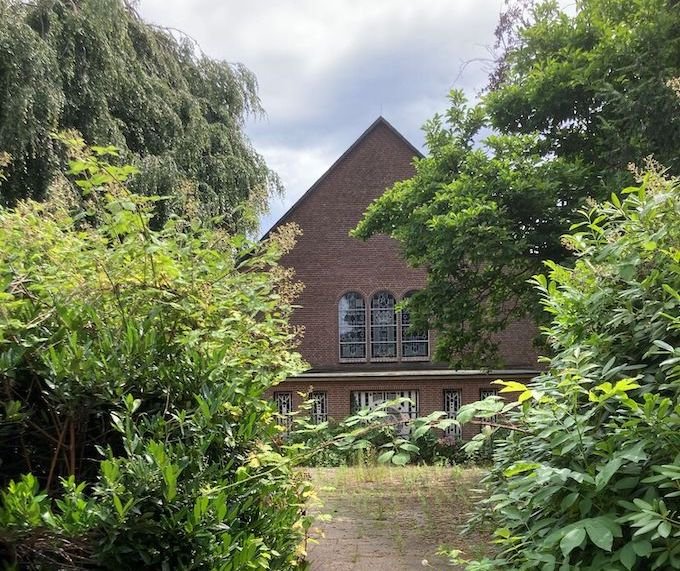
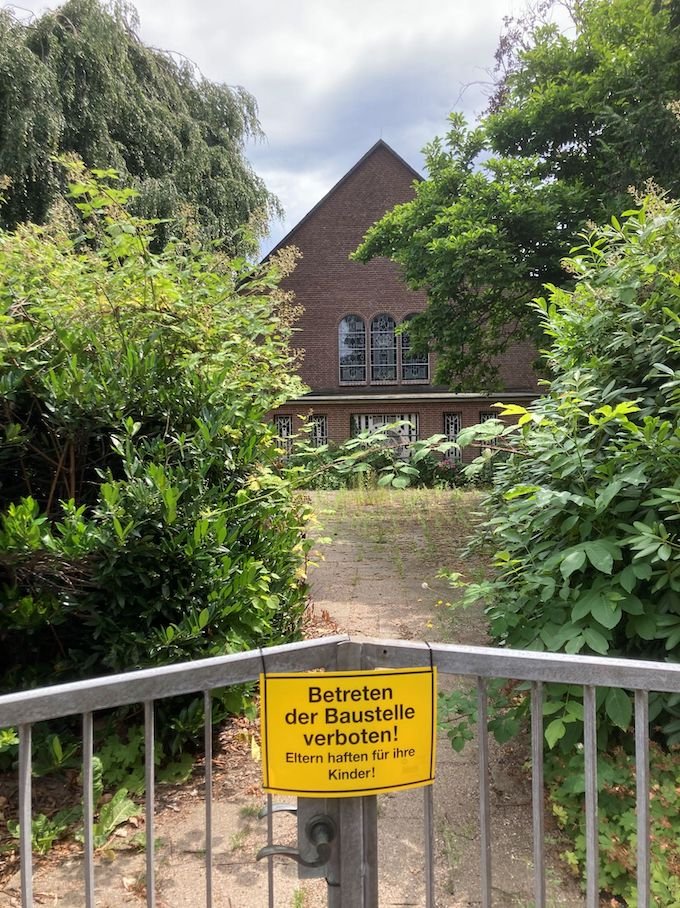
When I grew up in a small town in the North of Germany, our local Catholic church was an integral part of my family’s life. Both of my parents (not originally from that part of Germany) were Catholic – in fact, they had met at regular, mockingly called ‘mixed marriage prevention balls’ which were afternoon dances organised by their Catholic church. We went to church every Sunday, both my brother and I were altar servers (I was one of the first female altar servers) and I had my first communion, my confirmation and, many years later, my wedding in our little church. Soon this little church will no longer be there. Its doors are already permanently locked, the weeds have grown knee-high between the flagstones, the brambles have managed to traverse across the path sleeping beauty-style and there is now a yellow sign on the gate prohibiting access. How did that happen?
When I was a child, our church was full every Sunday. We had our own priest just for that Parish, who lived next door, had a house keeper, loved his cigars, wore a Breshnev-style hat in winter and loved to tell the story of how the bible he had carried in his breast pocket had saved him from a bullet in the war (which made him well up every time). In fact, the church really only existed because of the war. The North of Germany is very much Protestant, and there had only been a tiny Catholic church in my hometown before the war. But as the refuges poured in from the Eastern regions that were no longer German, they brought their Catholic faith with them and with it a need for a bigger church in their new community. As a consequence, all the streets around our church carry the names of their lost homes: “West-Prussia Street”, “Masuria Path”, “East-Prussia Street”, “Pomerania Street” etc.
We even had a lively youth group where I made some really good friends, but as we grew up and moved elsewhere, there did not seem to be any new young people to replace us. The church emptied more and more. When our priest retired, we had to share a priest with two other neighbouring towns, which became more in the years that followed. Eventually, the change of priests became more frequent as they were moved around to cover an increasingly larger area. After COVID only a handful of old people still went to mass regularly, and then it was announced that, for financial reasons, a number of churches in our diocese would be closed, demolished and the land sold – including ours. The Catholic Church is in decline in Germany. To my Dad’s shock, the priests he talked to seemed to be resigned to it as if it were time for something new. It would be so nice if that ‘something new’ included reforms in the Catholic Church that, quite literally, ‘restored faith’ in the people – because this can’t be it, can it?!
Katrin Ottersbach
Leave a Reply